
One egg, one guest
Every guest receives their own egg, graded by Chef’s own hand and folded at the table. In thirty years he has never delegated an omelette.
Chef de cuisine
“Un œuf, c’est un paysage que l’on peut plier.”
An egg is a landscape you can fold.
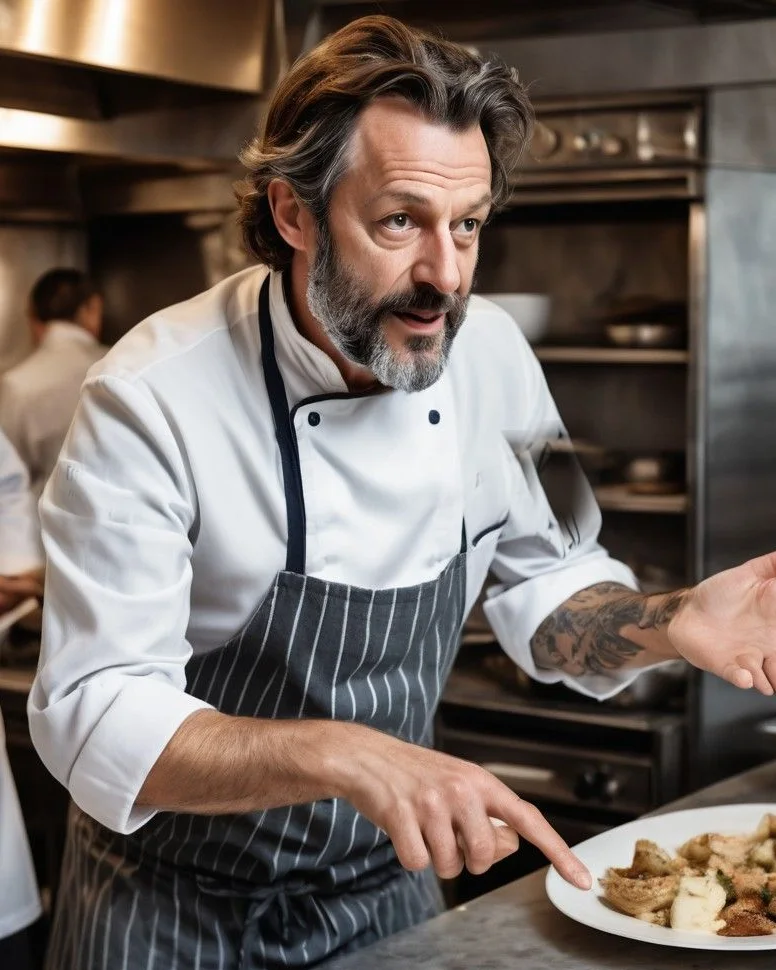
Burciel de Chivers was born in Arles, on the northern edge of the Camargue, where the flamingos stand in the salt lagoons and the sky is never empty.
His grandmother kept geese. His grandfather kept a notebook in which he recorded, every morning for forty-one years, which birds had flown over the house. The young Burciel read it the way other children read fairy tales, and by the age of nine could identify a curlew by its silhouette and a quail’s egg by its weight in the palm.
He has never, in his career, cooked with a chicken egg. When asked why, he replies only that the chicken “has not been anywhere”.
The peregrine is the fastest creature on earth. It has seen more of Belper in one morning than most people see in a lifetime. That is what you are tasting.
Formation
Most chefs train in kitchens. Chef de Chivers trained in colonies.
Over two decades he worked his way across the great bird habitats of Europe, not as a forager but as a student, living alongside the birds through entire breeding seasons and cooking only what the season allowed, which was, frequently, nothing at all.
A diploma in the culinary arts at Saintes-Maries-de-la-Mer, followed by a thesis, L’Œuf comme paysage, written in a hide beside the flamingo lagoons and still read in French culinary schools today.
Three winters and three summers off the coast of East Lothian among the largest colony of northern gannets in the world. He learned to cook in a gale, and took from the colony a lifelong devotion to precision and order.
Six years on the great heron lake south of Nantes, where he developed his signature technique of folding an omelette in complete silence so as not to disturb the egrets.
A study of the puffin, the tern and the eider: of patience, of seasonality and of the respect owed to a wild ingredient. He describes this period as formative.
His own restaurant, in a decommissioned lighthouse on the Breton coast: twelve covers, a single tasting menu and a waiting list that ran to three years. He closed it in 2025 to search for a new eyrie.
Arriving by train, he looked up from the platform and saw a peregrine stoop from the tower of the East Mill. He did not get back on.
Méthode
Every guest receives their own egg, graded by Chef’s own hand and folded at the table. In thirty years he has never delegated an omelette.
He does not own a whisk and regards them as “a confession”. Every egg is beaten with one fork, from Sheffield, in a copper bowl that once belonged to his grandfather.
La Plume d’Or (2009). La Coquille de Cristal (2016). La Toque d’Argent (2021).